
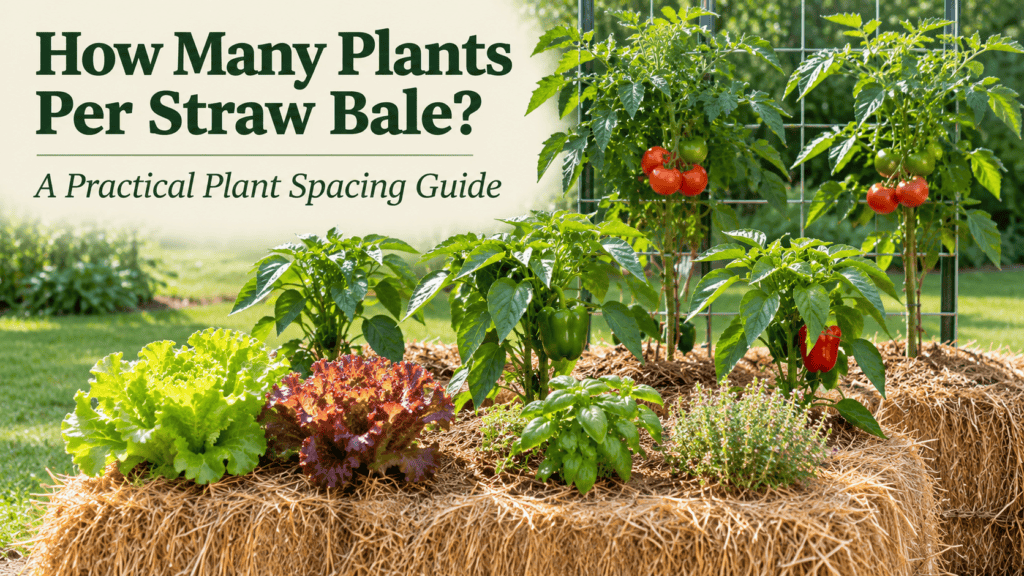
One straw bale can hold more plants than many first-time gardeners expect.
The exact number depends on what you grow.
A large tomato plant may need much of the top of a bale to itself, while lettuce, herbs, and other smaller crops can grow much closer together. You can also use the sides and ends of the bale, not just the top.
The most important rule is simple:
Plan for the mature size of the plant, not the size of the seedling when you put it into the bale.
A tiny tomato transplant in spring can become a large plant by midsummer. If you crowd several large plants together at the beginning, you may end up with poor airflow, tangled growth, and difficult harvesting later.
Quick Answer: How Many Plants Fit in One Straw Bale?
There is no single number for every crop.
As a general starting point:
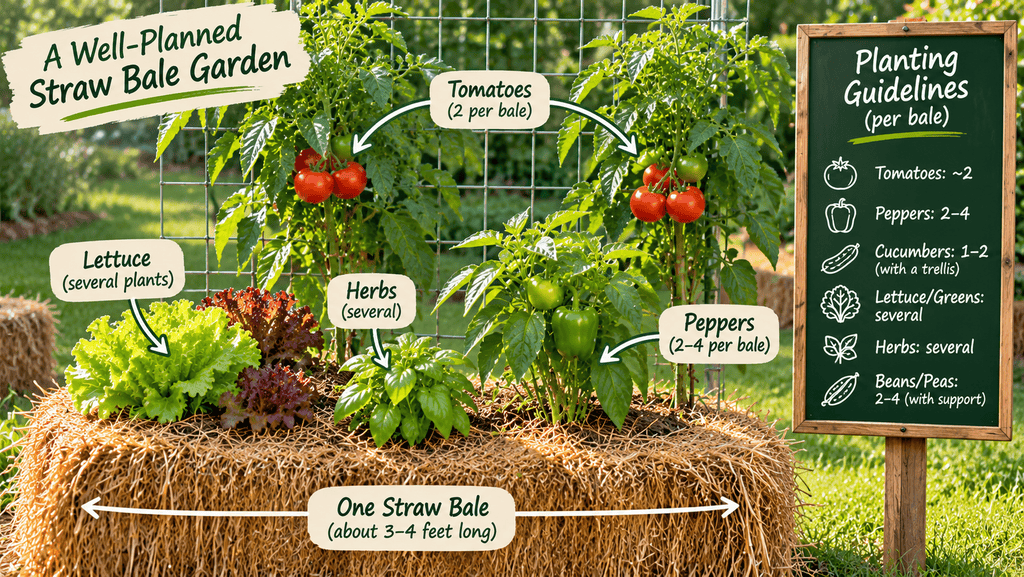
- Tomatoes: about 2 plants per bale
- Peppers: about 2–4 plants per bale
- Lettuce and leafy greens: several plants can fit because they need less space
- Herbs: several smaller herbs can share a bale
- Cucumbers: spacing depends heavily on whether they are grown vertically
- Squash and pumpkins: usually need considerably more room to spread
- Beans and peas: can make better use of space when trained vertically
Joel Karsten has also demonstrated that some bales can support several different plants at once when the top, sides, and ends of the bale are used efficiently.
That does not mean every bale should contain seven or eight large vegetable plants.
Plant size matters.
Why Plant Spacing Matters in a Straw Bale Garden
Straw bale gardening gives you a compact growing area, but plants still compete for:
- Light
- Water
- Nutrients
- Airflow
- Physical growing space
Overcrowding can cause several problems.
Leaves overlap heavily, Plants shade one another.
Harvesting becomes difficult.
Air movement through the garden decreases.
Vines become tangled.
Larger plants can overwhelm smaller ones.
Spacing becomes even more important with vigorous crops such as tomatoes, squash, cucumbers, and pole beans.
A conditioned straw bale can support strong plant growth, so it is better to leave enough space early than to discover halfway through summer that the garden has become unmanageable.
How Many Tomato Plants Can You Grow in One Straw Bale?
A useful general guideline is:
About two tomato plants per bale.
Tomatoes can become much larger than they appear when you first transplant them.
Two healthy tomato plants can develop substantial root systems, stems, leaves, and fruit throughout the season.
Giving them sufficient space helps:
- Improve airflow
- Make pruning easier
- Give the plants better access to light
- Make harvesting simpler
- Keep vines easier to support
Tomatoes should also have proper support.
The Straw Bale Gardens method uses trellising, cages, stakes, or other support systems to keep large plants upright and make better use of vertical space.
For more detail on supporting large plants, see the existing Straw Bale Garden Wire Trellis guide on StrawBaleGardens.com.
Can you put more than two tomato plants in a bale?
You may physically be able to fit more, but that does not automatically make it a better garden.
Variety matters.
A compact or determinate tomato may require less room than a large indeterminate variety.
When planning your garden, always consider how large that specific variety will become by midsummer.
How Many Pepper Plants Per Bale?
Peppers generally require less space than large tomato plants.
A useful starting range is:
About two to four pepper plants per bale.
The exact number depends on the pepper variety.
Compact pepper plants can usually be placed closer together than varieties that develop into wide, heavily branched plants.
When planting several peppers in one bale, space them so each plant can receive direct light without being completely covered by its neighbors.
How Many Cucumber Plants Per Bale?
Cucumbers are different because much of their growth comes from vines.
The best use of space is often to grow them upward rather than allowing all of the vines to spread across the bale and ground.
A trellis can:
- Move vines away from neighboring plants
- Improve airflow
- Keep fruit easier to find
- Use vertical space
- Prevent the garden from becoming tangled
The exact number of cucumber plants should depend on the variety and the support system you are using rather than trying to force a fixed number into every bale.
For vigorous varieties, fewer well-supported plants may produce a more manageable garden than several crowded vines.
Lettuce and Leafy Greens
Lettuce, spinach, kale, and other leafy greens can generally be planted more densely than tomatoes or squash.
These plants usually have:
- Smaller root systems
- Less sprawling growth
- Shorter growing periods
- Less need for heavy support
That makes them useful when you want to get more production from one bale.
For direct seeding, prepare a shallow planting layer on top of the conditioned bale and follow the spacing recommendations for the specific variety you are planting.
The official Straw Bale Gardening for Beginners guide explains how a shallow layer of quality planting mix can be used when sowing small seeds directly on top of a conditioned bale.
A useful strategy
Instead of planting every lettuce plant at the same time, consider staggering planting dates.
That can give you harvests over a longer period rather than having every plant mature at once.
Herbs
Many herbs are well suited to the smaller spaces available around larger vegetables.
Depending on the herb, you may be able to plant several in one bale.
Good candidates can include compact herbs that do not develop enormous root systems or canopies.
However, avoid treating all herbs alike.
Some remain small.
Others spread aggressively.
Again, mature plant size should determine spacing.
Herbs can also make good use of spaces that would be inefficient for another large vegetable plant.
Squash and Zucchini
Squash plants can become enormous.
A seedling that occupies only a few inches of space when planted can eventually produce large leaves and long stems.
For that reason, squash generally needs more room than peppers, lettuce, or herbs.
Do not crowd several large squash plants onto one bale simply because they physically fit at planting time.
Allow room for the plant to expand beyond the bale.
You can position sprawling plants near the outer edge so vines can grow away from the center of the garden.
What About Pumpkins?
Pumpkins need similar planning.
Their vines can travel well beyond the bale.
If you grow pumpkins in a straw bale garden, think about where those vines will go before planting.
Avoid placing sprawling crops where they will block:
- Walkways
- Other bales
- Irrigation lines
- Access to neighboring plants
A successful layout considers the space around the bale as well as the space directly on top of it.
Beans and Peas
Climbing beans and peas can make excellent use of vertical growing space.
Instead of giving each plant a large horizontal footprint, train suitable varieties upward on a trellis.
This lets you use the top of the bale more efficiently while keeping the vines organized.
Joel’s Straw Bale Gardens system makes frequent use of vertical support because the trellis can increase usable growing space while improving airflow through the garden.
Bush varieties behave differently, so choose spacing according to the variety.
How Many Potato Plants Per Bale?
Potatoes behave differently from many above-ground vegetables.
They can be grown in first-year bales, but Joel also specifically recommends potatoes as a useful crop for more decomposed second-year bales.
Older bales have already broken down substantially, creating a loose environment that can work particularly well for root crops.
Rather than overcrowding potatoes, give them enough space for tubers to develop inside the decomposing material.
For detailed potato-growing information, see the existing You’ll Never Grow Potatoes Any Other Way Again article on StrawBaleGardens.com.
What About Carrots and Other Root Crops?
Carrots can also grow successfully in straw bales.
Like potatoes, they can perform particularly well as the bale becomes softer and more decomposed.
Second-year bales can be especially useful for crops such as:
- Carrots
- Potatoes
- Lettuce
- Spinach
Because the bale has already decomposed substantially, the growing environment is different from a newly conditioned first-year bale.
Can You Plant Flowers in Straw Bales?
Yes.
Flowers can be grown alongside vegetables, and smaller flowering plants can help make use of spaces around the edges and sides of the bale.
The key is not to let ornamental plants crowd the vegetables you actually want to harvest.
When combining flowers and vegetables, consider:
- Mature plant size
- Root competition
- Sunlight
- Water demand
- Plant height
A tall flower placed directly in front of a smaller vegetable can create unnecessary shade.
Don’t Forget the Sides of the Bale
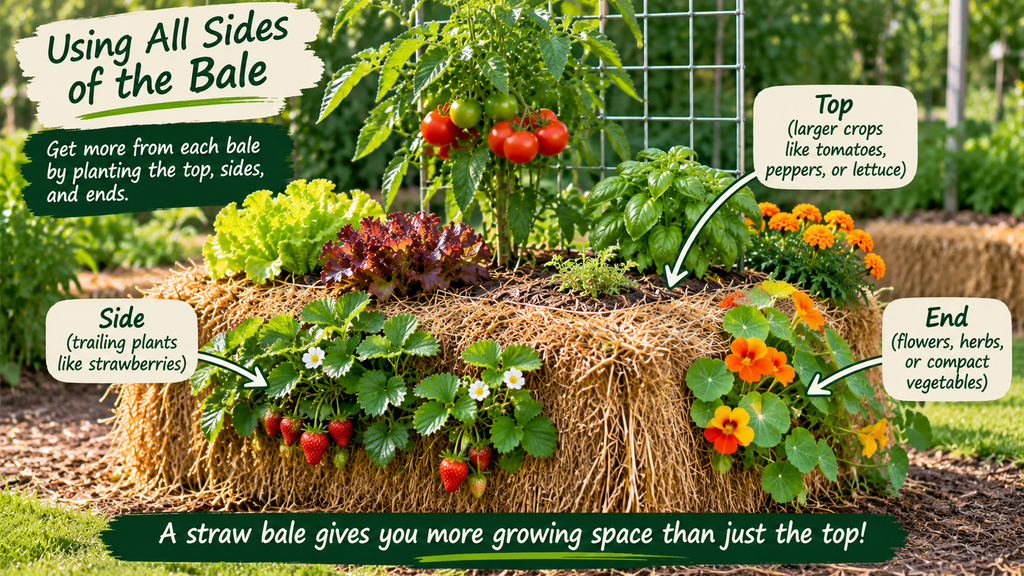
One of the most useful things about Straw Bale Gardening is that the top is not your only planting area.
Joel has demonstrated gardens where the:
- Tops
- Sides
- Ends
of the bales are all used.
This can significantly increase the amount you grow without forcing every plant onto the top surface.
Smaller crops, flowers, and suitable trailing plants can often make better use of these additional spaces.
Joel has said that if you can still see large amounts of exposed straw by midsummer, there may still be room to grow something else.
The key is intelligent use of space, not simply overcrowding.
Trellising Changes How Much You Can Grow
Vertical gardening can dramatically change the layout of a straw bale garden.
Consider two cucumber plants.
Without support, their vines may spread across neighboring bales and walkways.
With a trellis, those same vines can grow upward.
The same principle applies to:
- Pole beans
- Peas
- Cucumbers
- Many tomato varieties
Using vertical space can leave more of the bale surface available for smaller plants.
The existing Straw Bale Garden Wire Trellis guide explains Joel’s approach to supporting climbing crops above bale rows.
Can You Mix Different Plants in One Bale?
Yes.
You do not have to plant one crop per bale.
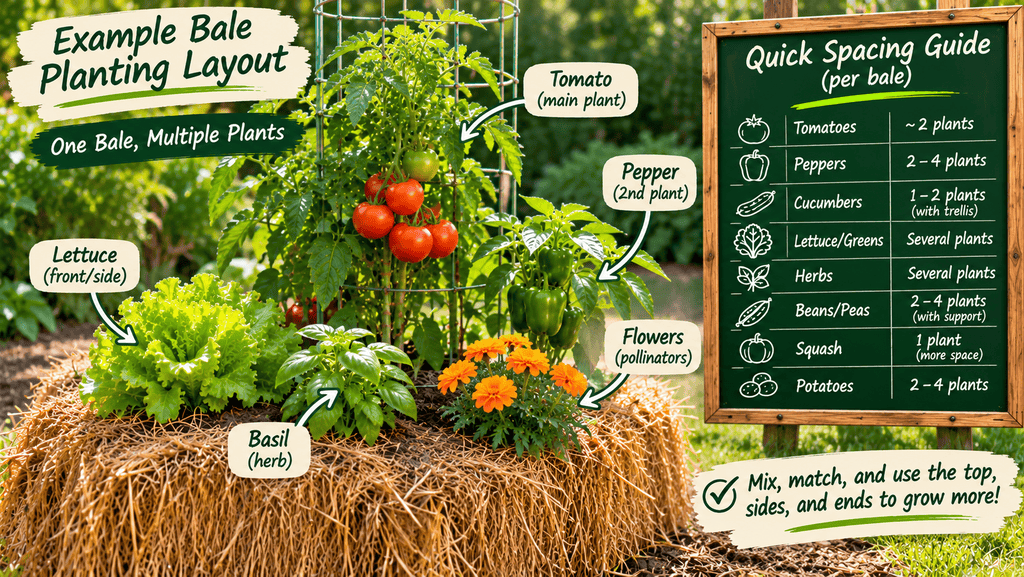
For example, a bale might contain a larger vegetable along with smaller plants positioned around it.
The important question is whether those plants will still work together when fully grown.
A useful way to think about mixed planting is:
Center or main planting area
Use this for the larger crop.
Remaining top space
Use for smaller plants that will not compete heavily.
Bale sides or ends
Use for suitable smaller or trailing plants.
Vertical space
Use trellises for climbing crops.
This creates several growing zones from one bale.
How Many Plants Is Too Many?
There is no universal maximum.
Joel has shown that some bales can support seven or eight plants when different growing areas and plant sizes are used efficiently.
But seven or eight tomato plants in one bale would be a very different situation from seven or eight smaller plants.
The better question is:
Will every plant still have enough space, light, water, and airflow when fully grown?
If the answer is no, reduce the number.
A Simple Straw Bale Plant Spacing Guide
Use this as a planning starting point rather than an absolute rule.
| Crop | General spacing approach |
| Tomatoes | About 2 plants per bale |
| Peppers | About 2–4 plants per bale |
| Cucumbers | Use fewer plants with vertical support |
| Lettuce | Plant more closely according to variety |
| Spinach | Can be planted relatively densely |
| Herbs | Several smaller herbs can share a bale |
| Squash | Give each plant substantial room to spread |
| Pumpkins | Allow plenty of surrounding vine space |
| Pole beans | Grow vertically to save space |
| Peas | Use vertical support where appropriate |
| Potatoes | Leave room for tuber development |
| Carrots | Can be grown more densely than large fruiting crops |
| Flowers | Use available space without crowding vegetables |
Always adjust for the actual variety you are growing.
A compact tomato and a vigorous indeterminate tomato do not require the same space.
Neither do a bush cucumber and a long-vining cucumber.
Plan for Mature Size, Not Planting-Day Size
This is probably the most important spacing principle.
When you visit a garden center, every transplant looks small.
That does not mean it will stay small.
Before planting, ask:
- How tall will this variety grow?
- How wide will it become?
- Does it vine?
- Does it need a trellis?
- Will it shade another plant?
- How difficult will it be to harvest?
- How much airflow will remain?
Thinking ahead prevents most spacing problems.
Common Plant-Spacing Mistakes
Filling Every Available Inch Immediately
Empty space in May does not mean wasted space.
Large summer crops will quickly expand into it.
Planting Too Many Tomatoes
Tomatoes can become large, heavy plants.
Giving them room and strong support usually works better than squeezing several onto one bale.
Ignoring Vertical Space
Cucumbers, beans, peas, and suitable tomato varieties can use a trellis instead of occupying all of your horizontal space.
Forgetting the Sides of the Bale
The top is only one possible growing surface.
Use the sides and ends where appropriate.
Ignoring Variety Differences
Two varieties of the same vegetable can have very different mature sizes.
Read the seed packet or plant label.
Making Harvesting Impossible
Leave enough space to reach fruit, inspect leaves, and maintain the plants.
A garden that looks full is not necessarily a garden that is easy to manage.
How Spacing Affects Watering
The more plants you place in a bale, the more competition there will be for available moisture.
A heavily planted bale may require closer observation during hot weather than a bale with only one or two plants.
Good irrigation also becomes more important as plant density increases.
The Straw Bale Gardens method favors directing water toward plant roots with drip irrigation or a soaker hose rather than simply spraying the entire garden from above.
How Spacing Affects Plant Support
Large crops become heavier as the season progresses.
Tomatoes develop fruit.
Cucumbers produce long vines.
Beans and peas climb.
Planning the support system at the same time as plant spacing prevents problems later.
Install trellises, posts, cages, or other supports before plants become difficult to manage.
FAQs
How many tomato plants can I put in one straw bale?
About two tomato plants per bale is a useful general starting point. Adjust for the variety and mature plant size.
How many pepper plants fit in one bale?
A general range is approximately two to four pepper plants per bale, depending on the variety.
Can I put more than one type of vegetable in a straw bale?
Yes. Mixed planting can work well when you combine plants with compatible mature sizes and growing habits.
Can I plant on the sides of a straw bale?
Yes. The sides and ends can provide additional growing space for suitable crops and flowers.
Can one straw bale hold seven or eight plants?
Some bales can support several plants when smaller crops, side planting, and vertical growing are used intelligently. That does not mean seven or eight large plants should be crowded onto the top.
Should I follow normal garden spacing recommendations?
Use the mature-size recommendations for your specific crop as an important reference, then adapt the layout to the bale and whether you are using vertical support.
Is overcrowding bad for a straw bale garden?
Yes. Too many large plants can reduce airflow, block light, increase competition for water and nutrients, and make harvesting more difficult.
Get More From Every Bale Without Overcrowding
Straw bale gardens can produce a surprising amount of food from a small footprint.
But productivity does not come from squeezing the maximum possible number of seedlings onto every bale.
It comes from using the space intelligently.
Give large plants enough room.
Grow climbing crops vertically.
Use smaller plants around larger ones where appropriate.
Take advantage of the sides and ends of the bale.
And always plan for what the garden will look like in midsummer, not what it looks like on planting day.
A little spacing at the beginning of the season can produce a healthier, easier-to-manage garden later.
For gardeners just getting started, the Straw Bale Gardening for Beginners guide explains the complete process from choosing and conditioning bales through planting and maintaining the garden.
