What Is Straw Bale Gardening? How This Soil-Free Growing Method Works
Imagine growing tomatoes, peppers, cucumbers, herbs, and flowers without digging up your yard, building traditional garden beds, or worrying about poor soil.
That is the idea behind straw bale gardening.
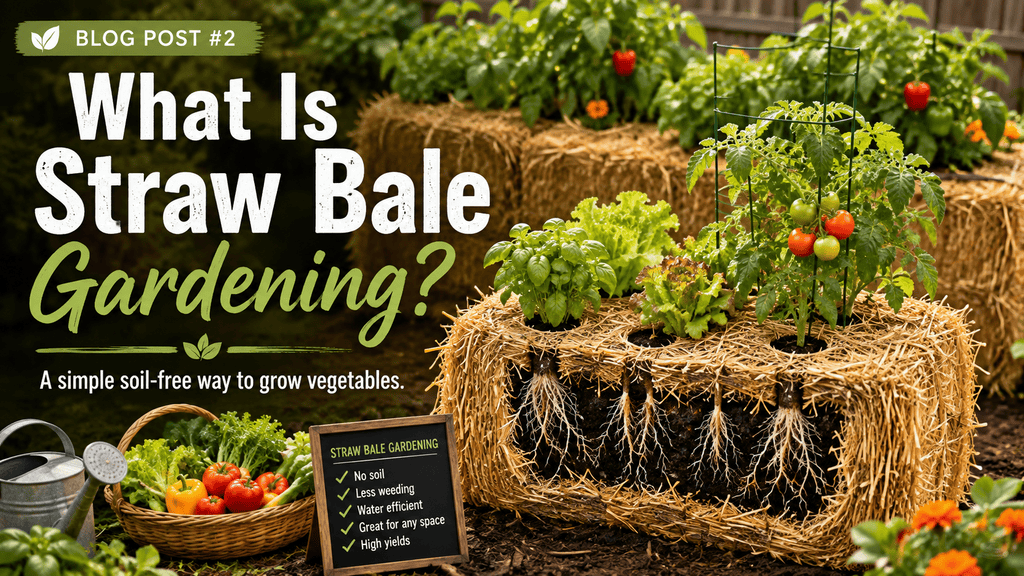
Instead of planting directly into the ground, a gardener uses a bale of straw as both the container and growing medium. Before planting, the bale is conditioned with water and nutrients. This starts decomposition inside the bale and gradually creates a warm, moist environment where plant roots can grow.
The STRAW BALE GARDENS® method pioneered by Joel Karsten has made this alternative gardening technique accessible to gardeners dealing with poor soil, limited space, or simply looking for a different way to grow food. (Straw Bale Gardens)
What Exactly Is Straw Bale Gardening?
Straw bale gardening is essentially a form of container gardening—but instead of using a pot, planter, or raised bed filled with soil, the straw bale itself becomes the container.
The important part is that gardeners don’t simply put a plant into a fresh, dry bale and expect it to grow.
First, the bale must be conditioned.
During conditioning, water and nutrients encourage microorganisms inside the bale to begin breaking down the straw. As decomposition progresses, the interior becomes softer, warmer, and more suitable for plant roots. (Straw Bale Gardens)
This is what makes straw bale gardening so interesting.
You’re not really asking a tomato plant to grow in dry straw. You’re creating a biologically active growing environment inside the bale.
How Does Straw Bale Gardening Work?
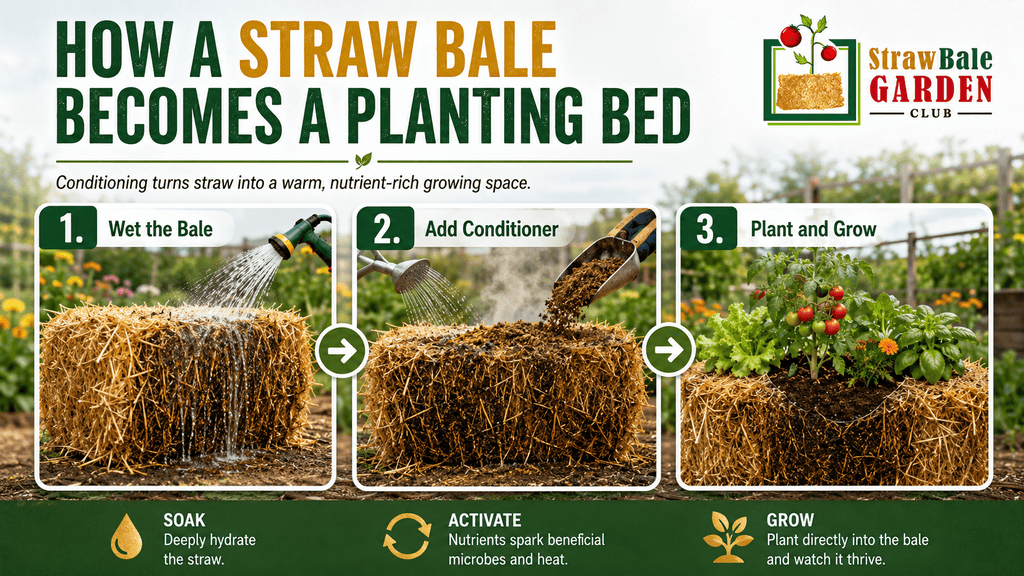
The basic method can be understood in three stages:
1. Position the Bale
First, place your straw bales where you want your garden.
Most vegetables perform best in a location receiving plenty of direct sunlight, and the garden should be reasonably close to a water source.
One major advantage is flexibility. Bales can be used where traditional gardening might be difficult, including areas with poor ground soil and even hard surfaces such as patios or driveways. (Straw Bale Gardens)
It’s best to position the bales before conditioning because they become much heavier after absorbing water.
2. Condition the Bale
Conditioning is the key step.
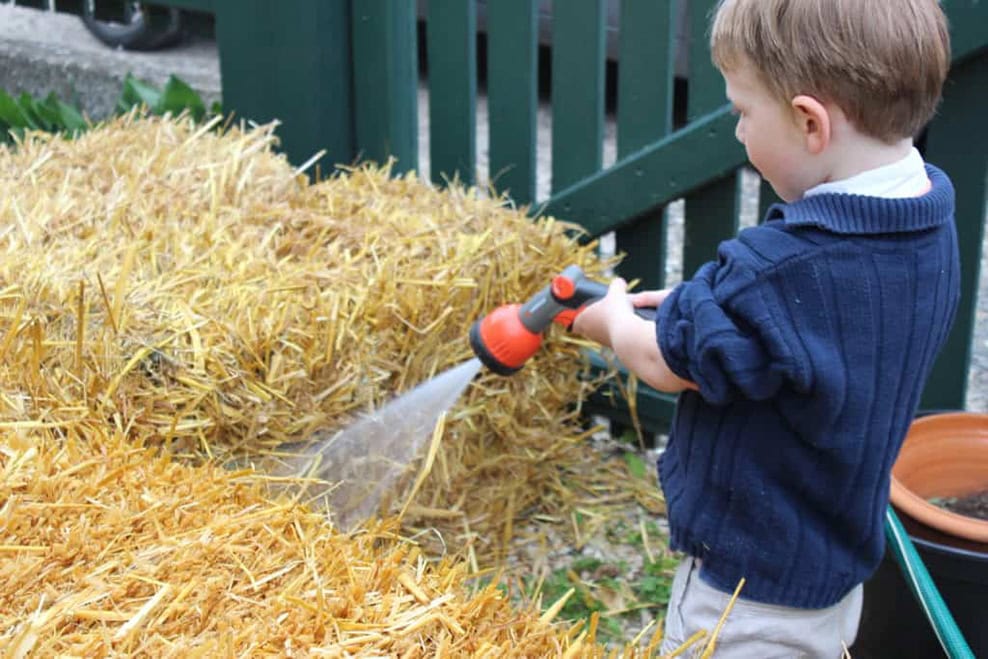
Water and nutrients are added to encourage microorganisms already present in the bale to multiply and begin decomposing the straw.
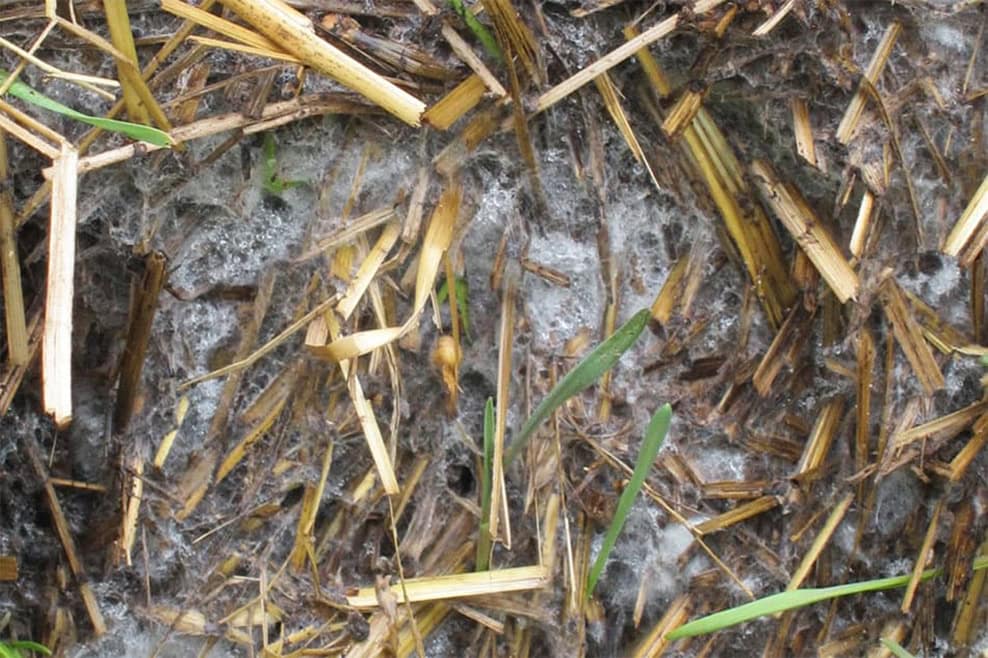
As microbial activity increases, the bale can become warm internally. Eventually, the straw begins transforming into decomposed organic material that provides a much better rooting environment.
The official Straw Bale Gardens guidance describes conditioning as an essential part of the method and recommends beginning the process roughly two weeks before the intended planting date. (Straw Bale Gardens)
3. Plant and Grow
Once the bale is properly conditioned and has cooled sufficiently, it’s ready for plants.
Seedlings can be planted into openings made in the bale. Seeds can also be grown by adding a shallow layer of suitable planting material to the surface.
From there, your plants need the same basic things as any productive garden:
Sunlight + Water + Nutrients + Regular Care
The difference is that their roots are growing through the decomposing interior of a straw bale instead of traditional garden soil.
What’s Happening Inside the Bale?
This is one of the most fascinating parts of straw bale gardening.
Think of the bale as a slowly transforming biological container.
At the beginning, you have tightly packed stalks of straw.
After water and nutrients are introduced, microorganisms become increasingly active. They begin consuming and breaking down the straw fibers.
As Joel Karsten explains, this microbial activity breaks down the straw and releases material from inside the stalks, gradually producing an environment similar to decomposed organic matter. (Straw Bale Gardens)
So the transformation looks roughly like this:
Fresh Straw → Conditioning → Microbial Activity → Decomposition → Rooting Environment → Plant Growth
The bale continues decomposing while your vegetables grow.
Why Not Just Plant in Regular Soil?
You certainly can.
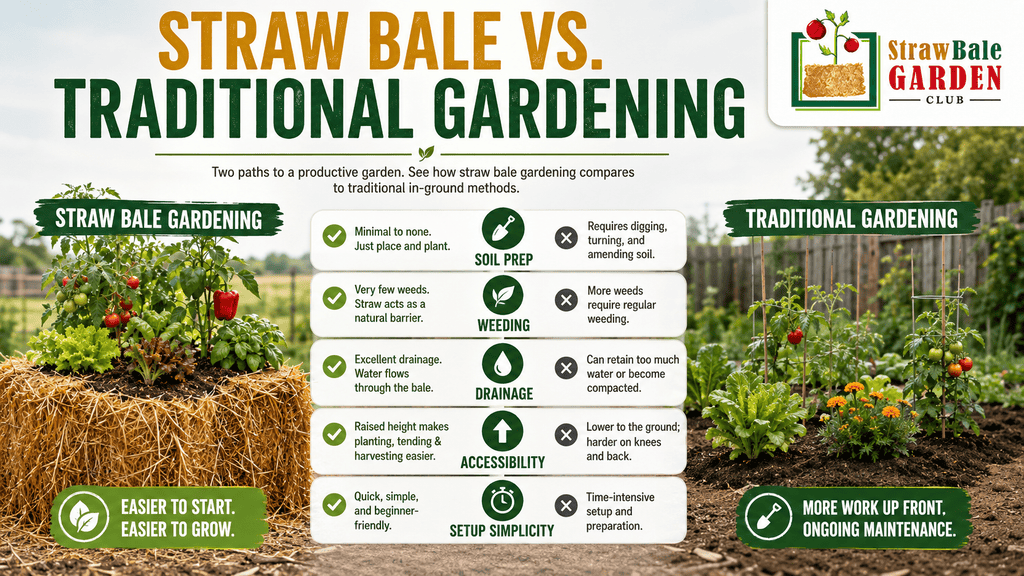
Straw bale gardening isn’t meant to suggest that ordinary soil gardening doesn’t work. Instead, it provides another option—especially where soil conditions make gardening difficult.
Imagine a homeowner whose yard contains:
- Heavy clay
- Rocky ground
- Compacted soil
- Poor-quality soil
- Very little usable garden space
Creating a traditional vegetable garden might require digging, soil amendments, raised-bed construction, or bringing in large quantities of growing mix.
A straw bale garden can bypass much of that preparation because the plants are growing primarily in the conditioned bale rather than depending on the soil underneath.
The official Straw Bale Gardens site specifically presents the method as useful for gardening in poor-soil areas and on surfaces such as patios and driveways. (Straw Bale Gardens)
What Is the Difference Between Straw and Hay?
This is an important distinction for beginners.
Straw is generally the dried stalk remaining after cereal grains such as wheat, oats, barley, or rice have been harvested.
Hay, on the other hand, is typically grass or other forage harvested as livestock feed.
Hay can contain viable seeds. Once you start adding water and nutrients, those seeds may germinate and produce unwanted growth across the bale.
Joel Karsten notes that hay can still work, but its seed content makes the results less predictable than straw. (Straw Bale Gardens)
For a beginner, tightly packed, good-quality straw bales are generally the simpler choice.
What Can You Grow in a Straw Bale Garden?
A surprising variety of plants can be grown this way.
Popular choices include:
- 🍅 Tomatoes
- 🥒 Cucumbers
- 🌶️ Peppers
- 🥬 Lettuce
- 🫘 Beans
- 🌿 Herbs
- 🥔 Potatoes
- 🎃 Squash
- 🌸 Flowers
Plant spacing still matters.
Large plants such as tomatoes and squash require more room, while leafy greens and herbs can usually be planted more densely.
Climbing vegetables such as cucumbers and pole beans can also benefit from trellises.
What Are the Main Benefits?
No traditional digging or tilling
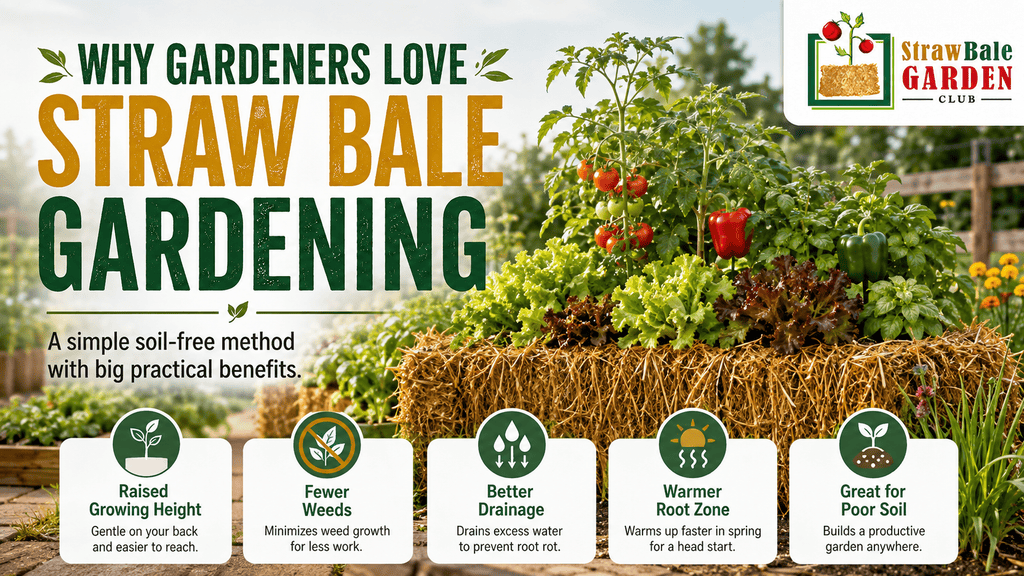
Because the bale becomes the growing environment, you don’t have to prepare the ground in the same way as a conventional vegetable garden.
Useful when soil is poor
This is perhaps one of the biggest attractions.
Your ground doesn’t need to provide the primary growing medium for the vegetables because the conditioned bale performs that role. (Straw Bale Gardens)
Raised growing height
A bale naturally elevates the plants above ground level.
That can reduce some of the bending associated with planting, maintaining, and harvesting a conventional ground-level garden. (Straw Bale Gardens)
Reduced weed pressure
Conditioned bales can dramatically reduce the amount of traditional soil weeding required compared with an ordinary garden bed. (Straw Bale Gardens)
Good drainage
The physical structure of straw allows excess water to drain rather than remaining trapped around plant roots.
Flexible placement
You don’t necessarily need a conventional vegetable plot.
A few bales can transform an otherwise unused sunny area into productive growing space.
Does Straw Bale Gardening Require Soil?
Not in the traditional sense.
That’s one of the defining features of the method.
The conditioned bale becomes the primary rooting environment. However, gardeners may still use a small amount of compost or planting mix when starting seeds or establishing transplants.
This is different from constructing a raised bed, where you might need to purchase enough soil or growing mix to fill the entire structure.
Is Straw Bale Gardening Good for Beginners?
Yes, particularly when the conditioning instructions are followed carefully.
The concept itself is straightforward:
Position → Condition → Plant → Water → Feed → Harvest
The most important part for a new gardener is resisting the temptation to skip conditioning.
A fresh straw bale isn’t the same as a conditioned one. Proper preparation allows the biological decomposition process to get underway before your vegetables depend on the bale for their growing environment. (Straw Bale Gardens)
Starting with just two to four bales can be a practical way to learn the method before creating a larger garden.
What Happens to the Bale After the Growing Season?
The bale gradually breaks down as the season progresses.
And that’s actually an advantage.
Instead of throwing the material away, the decomposed straw can become useful organic matter for the rest of your garden.
It can be:
- Added to compost
- Used around garden beds
- Used as mulch where appropriate
- Incorporated into future gardening areas
Some sufficiently intact bales may even be useful for another growing season, depending on their condition. The Straw Bale Gardens beginner guidance notes that partially decomposed second-year bales can work particularly well for certain cool-season crops. (Straw Bale Gardens)
Who Is Straw Bale Gardening For?
You might particularly enjoy this method if you:
- Have poor or compacted soil
- Have limited gardening space
- Want to avoid tilling
- Prefer a raised growing surface
- Garden on a patio or driveway
- Want to reduce traditional weeding
- Are experimenting with alternative growing methods
- Simply want to try something new
It can work for complete beginners as well as experienced gardeners looking for a different growing system.
The Simple Idea Behind Straw Bale Gardening
At first glance, growing vegetables from a bale of straw might seem unusual.
But the idea becomes much easier to understand when you realize that the bale isn’t staying as dry straw.
You’re deliberately starting decomposition.
Microorganisms begin breaking down the bale. Its interior changes. Roots establish themselves within that decomposing organic material, and the bale becomes both the container and the growing environment.
That’s the heart of straw bale gardening.
Start with straw.
Activate decomposition.
Create a growing environment.
Plant your vegetables.
Harvest fresh food.
You don’t need perfect soil to start a productive garden—you need the right preparation and a properly conditioned bale.
Ready to Learn How to Do It?
Now that you understand what straw bale gardening is, the next step is learning exactly how to prepare your first bales.
Explore the beginner guides, conditioning instructions, videos, books, and resources available from Straw Bale Gardens.